



INTRODUCTION
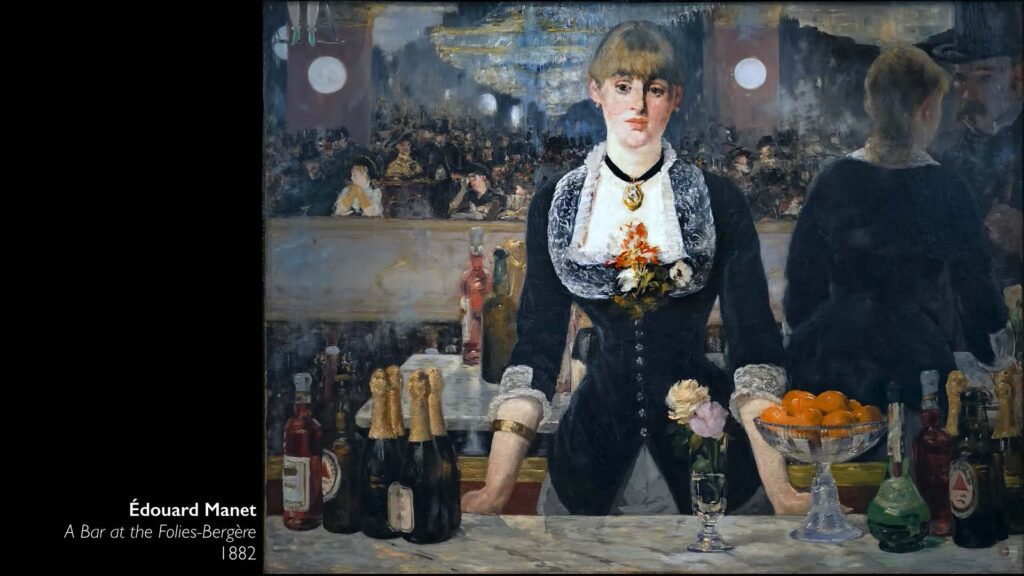
Édouard Manet’s A Bar at the Folies-Bergère (1882) is widely regarded as his final masterpiece — and one of the most quietly unsettling paintings in Western art. On the surface, it is a dazzling depiction of fin-de-siècle Parisian nightlife: marble countertops gleaming with bottles, a chandelier blazing above, a crowd caught in perpetual motion. But at the centre of all this glitter stands Suzon — a barmaid whose gaze travels nowhere, whose presence feels oddly still, almost out of reach.
In a single canvas, Manet compressed portraiture, social commentary, still-life painting, and a radical experiment in visual perception. Nearly a century and a half later, the painting continues to yield new meanings with every careful look. This essay walks through it, step by step.
“He made the ordinary strange, and the strange feel ordinary — and in doing so, he
invented modern painting.”
A CLOSE READING
Step 1: Entering the World of the Folies-Bergère
By the 1880s, the Folies-Bergère was the most famous — and most fashionable — entertainment venue in Paris. Trapeze artists, acrobats, chanteuses, and dancers performed beneath gaslit chandeliers, while Parisian society mingled in a setting that blurred the boundary between spectacle and social display. Manet had visited the venue himself, making preliminary sketches of the bar and its workers. Rather than painting the performance, Manet painted the margin of it: the bar, where entertainment and commerce, pleasure and labour, met face to face. This choice is deliberate. The Folies-Bergère is the backdrop, not the subject.
Step 2: Meeting Suzon
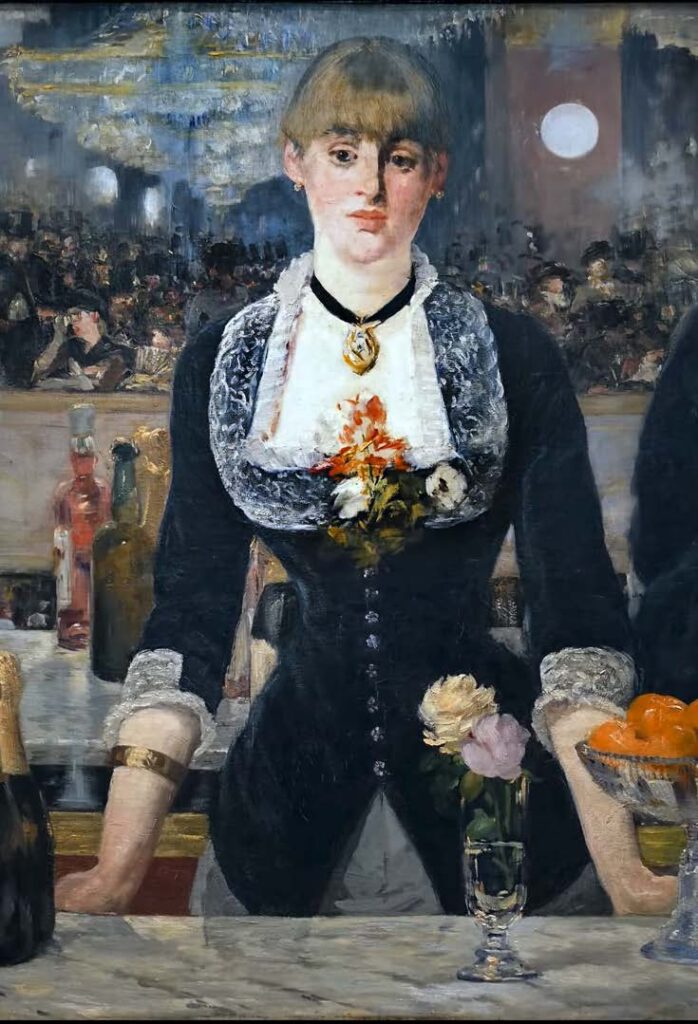
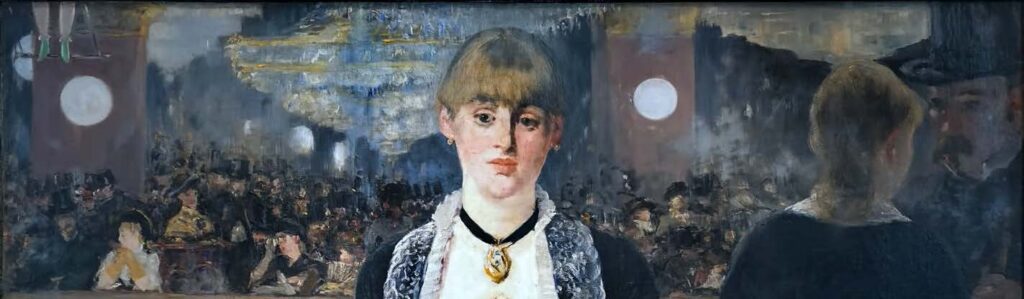
At the centre stands Suzon — an actual barmaid employed at the Folies-Bergère, whom Manet painted from life in his studio. She is composed, formally dressed in black with a spray of artificial flowers at her collar. Her posture is upright and professional. Her hands rest lightly on the marble counter as though she has stood this way a thousand times before — because she has. Manet gives her the visual weight normally reserved for historical subjects or mythological figures. She is not a backdrop; she is the painting.
Step 3: The Eyes That Refuse to Celebrate
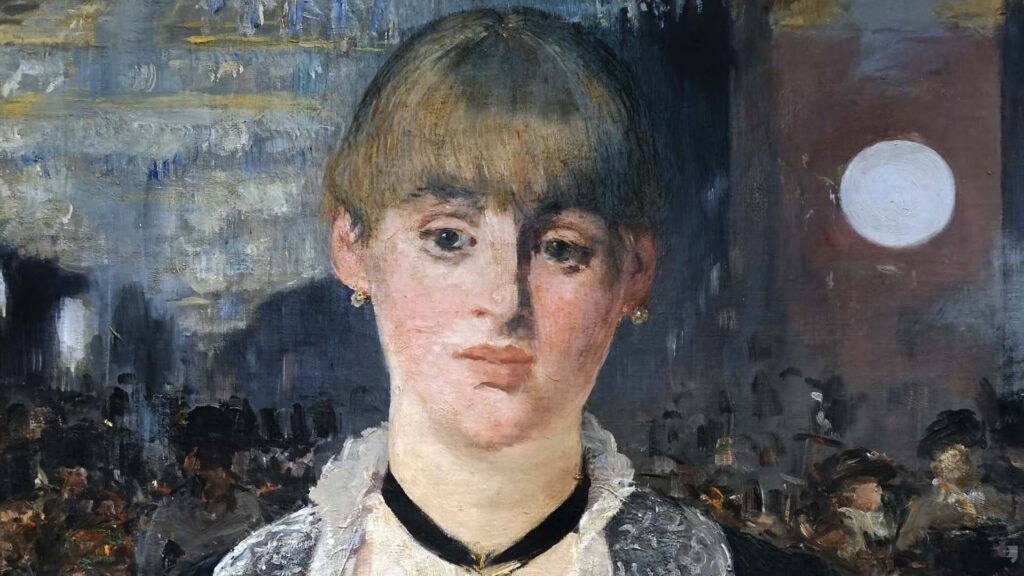
Suzon does not smile. She does not engage. Her gaze is directed slightly past the viewer — present in body, elsewhere in mind. It is one of the most arresting expressions in European painting: not melancholy, not defiance, not boredom exactly, but a profound and very modern kind of inwardness.
T.J. Clark, in The Painting of Modern Life, reads this expression as the face of alienated labour — the worker who must sell not just her time but her pleasantness, her availability, her cheer. Suzon’s gaze is a quiet refusal of that contract.
Step 4: The Strange Mirror
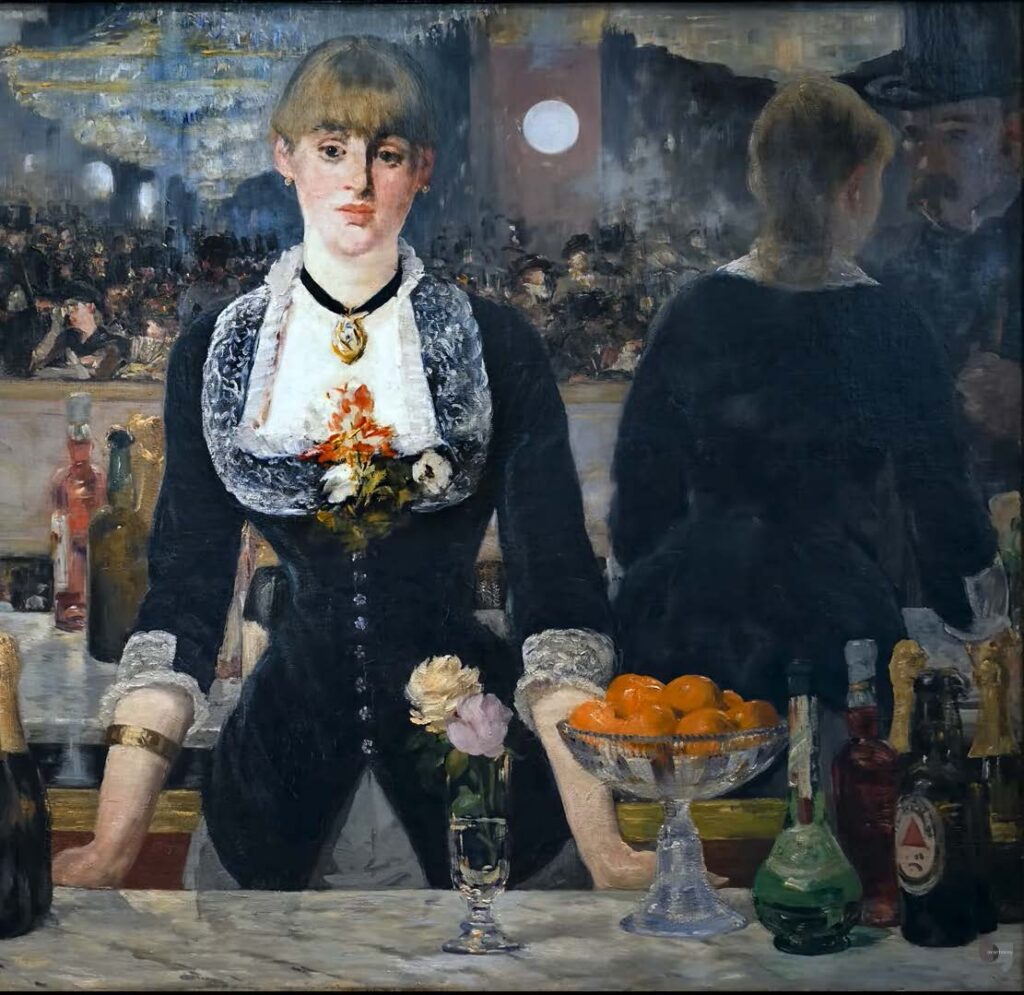
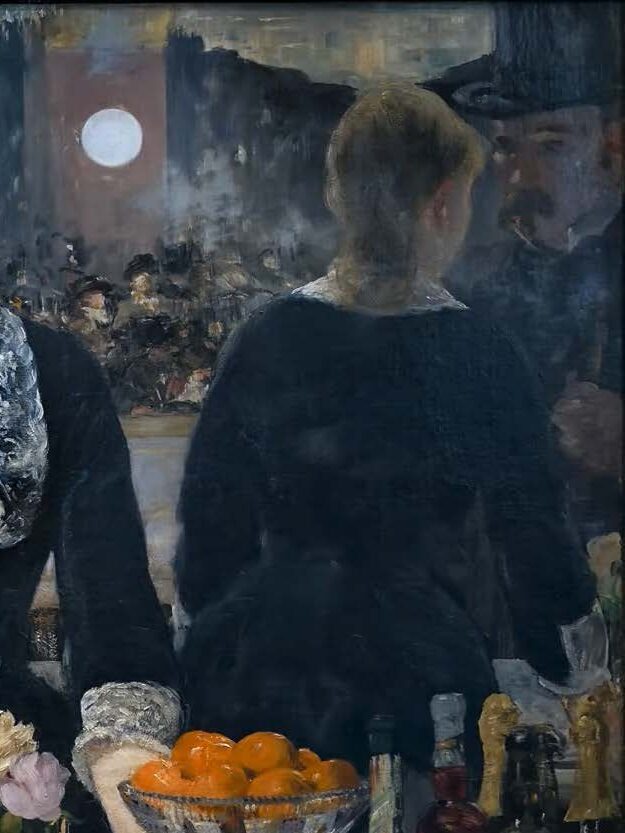
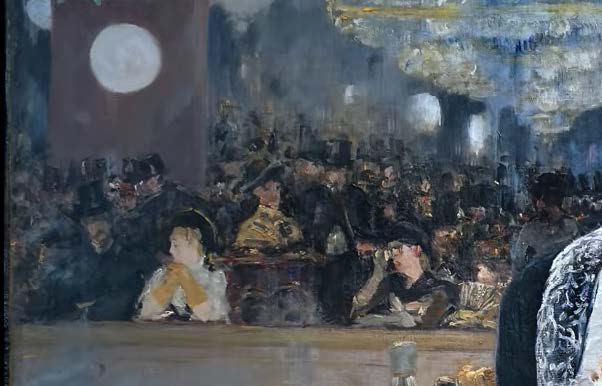
Behind Suzon, a large mirror reflects the interior of the Folies-Bergère: a sea of audience faces, hats, evening gowns, and the warm glow of artificial light. But the reflection is subtly, deliberately wrong. The geometry does not add up. If we were standing where the viewer stands — directly in front of Suzon — her reflection should appear almost directly behind her. Instead, it is shifted markedly to the right. This is not a painter’s error. Manet was meticulous.
Scholars have proposed several explanations: that the painting shows two simultaneous moments in time; that Manet deliberately distorted the perspective to heighten the sense of unreality; or that the mirror represents the subjective experience of vision rather than its mechanical accuracy. The mirror in this painting is not a device that clarifies — it is one that multiplies
uncertainty.
Step 5: The Man in the Reflection
In the mirror’s reflection, to Suzon’s right, a top-hatted man leans toward her, apparently in conversation. In the “real” space of the painting — the space the viewer occupies — no such man is visible. He exists only in reflection. His presence introduces the transactional reality behind the spectacle. The man is almost certainly a customer. In the social world of the Folies-Bergère, barmaids occupied an ambiguous position: simultaneously workers, social entertainers, and, for some customers, available companions. Manet does not spell this out. He lets the reflected figure speak for itself.
Step 6: The Language of Objects
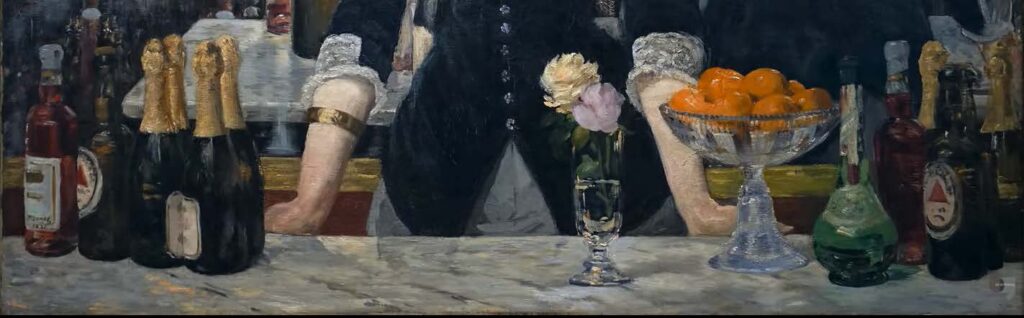
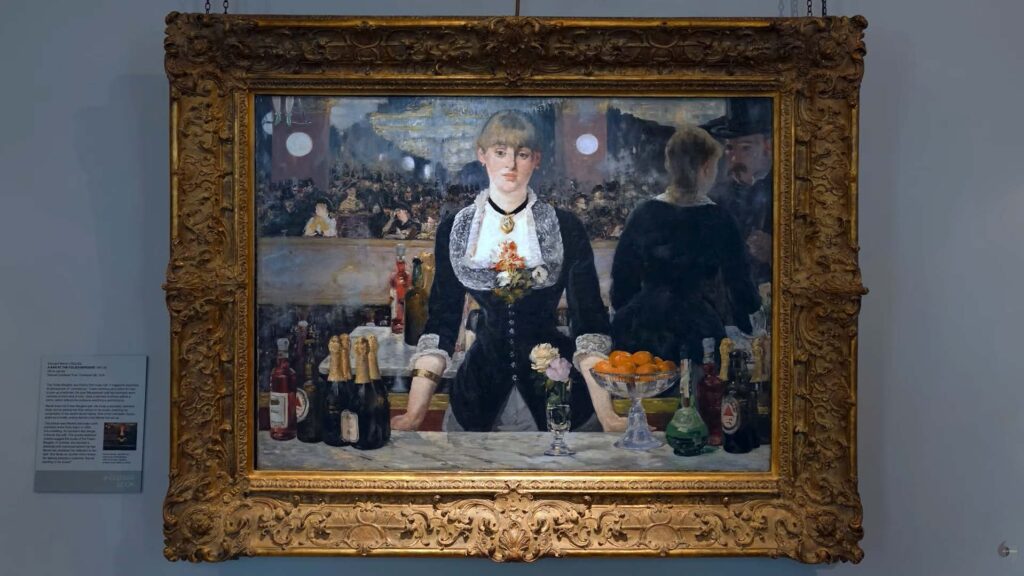
The marble counter is arranged with extraordinary care: bottles of Bass ale (their red triangle logo clearly legible), champagne, liqueur, a glass bowl of tangerines, roses in a vase, a compact. Each object is rendered with the painterly bravura of a Dutch still life — and each carries meaning.
The bottles signal commerce. The flowers signal femininity. The compact signals vanity, or perhaps self-presentation. The tangerines introduce warmth and colour in a setting that is otherwise cool and artificial. Together, these objects constitute the bar’s visual language —the merchandise of pleasure.
Step 7: The Oranges — or Tangerines
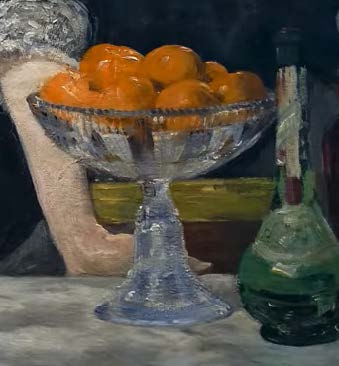
The bowl of bright citrus fruit in the lower right corner draws the eye immediately. Art historians have read it variously as a symbol of luxury goods accessible to the emerging bourgeoisie, as a reference to exotic import trade, and — more provocatively — as a symbol of female sexuality or commercial temptation borrowed from older still-life traditions. Whether or not Manet intended all of these readings, the fruit functions visually as a point of warmth and earthiness in a painting that can feel, at times, glacially elegant.
Step 8: The Trapeze Artist Above
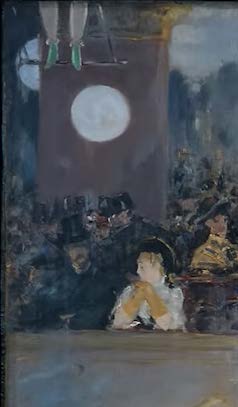
In the upper left corner of the canvas — easy to miss, easy to forget — a pair of green-slippered legs hangs in midair. They belong to a trapeze artist mid-performance. Manet crops the figure almost completely out of the frame, leaving only the feet. The effect is striking: the performance that everyone in the Folies-Bergère has come to see is reduced to a marginal detail. Gravity defying spectacle exists at the very edge of perception. Meanwhile, Suzon — serving drinks, standing still — occupies the centre.
Step 9: Isolation in a Crowd
The painting’s deepest subject may be loneliness — not the romantic, literary kind, but the particular loneliness of the urban worker surrounded by strangers who look through rather than at her. The reflected crowd is vivid and animated. Suzon, in the foreground, is still. The contrast is precise and intentional. Manet understood — perhaps from his own experience of illness by this point — that a room full of people offers no guarantee of company.
Step 10: Manet’s Farewell to Modern Paris
Manet painted A Bar at the Folies-Bergère in 1882, one year before his death. He was suffering from locomotor ataxia, a neurological condition that left him barely able to walk, and worked on the canvas with great difficulty. It was exhibited at the Salon of 1882 — his last major submission. The painting can therefore be read as a valediction: a final, considered statement about the city he had spent his career painting. Not a celebration, but a clear-eyed reckoning — with modernity, with pleasure, with the human beings who make pleasure possible for others.
Step 11: The Final Reflection
What makes A Bar at the Folies-Bergère inexhaustible is that it refuses to settle. The mirror continues to generate contradictions. Suzon’s gaze remains unreadable. The reflected man’s purpose is ambiguous. The geometry does not resolve. Every generation of viewers has found something different in this canvas — a meditation on gender, on class, on perception, on the nature of representation itself. That capacity to remain open is the mark of a great painting. Manet died before he could paint another.
HISTORICAL IMPORTANCE
Today, A Bar at the Folies-Bergère is held in the Courtauld Gallery, London, where it is the collection’s most celebrated work. It is universally regarded as a cornerstone of nineteenth century art and a bridge between Realism and the Impressionist and Post-Impressionist movements that followed.
It raises questions that have become foundational to modern art history: What does a painting owe to visual accuracy? Who is the implied viewer? Whose labour sustains leisure? In asking these questions — without answering them — Manet produced a work of enduring relevance.