



Leonora Carrington: As Virginia Woolf once said, “A woman must have money and a room of her own if she is to write fiction.” While it remains true for a writer, Leonora Carrington left the space of her room and stepped out in the garden; to paint.
My Dear Mother Earth
Leonora Carrington, a British painter and writer, placed her foot in Surrealism when it was dominated by men, as are most fields. However, she was a rebellious woman who had been previously expelled from two Catholic schools as a child so she believed she would do just fine, and she did – more than just fine.
Coming from a long line of a magical race (as she was told by her mother), Carrington was highly intuitive and deeply connected with Nature — perhaps it was because of this that she always had a vision of a home just for women writers and painters build in Nature. Because just like Woolf, she believed that women’s creativity thrives when they have a space of their own where nobody is robbing them of education and creative opportunities.
But, Carrington made a little addition of her own to Woolf’s idea – a beautiful garden. A space where one is connected to the soil, and inspiration resides all around.
Further Down, Down Below
19 year old Leonora Carrington fell in love with a man 4 times her age – the 46 year old surrealist painter Max Ernst. Their relationship was unacceptable to her father which is why they moved to France in 1937 where she met a lot of other famous painters and became a part of their artistic circle.
But soon she was forced to flee France in 1940 when it was under the Nazi occupation. Ernst was detained and Carrington was sent to an asylum in Spain; and with that, their relationship came to an end. During that period she suffered a complete mental breakdown and painted Down Below (1940) – something that feels like an explosion after years of suppression.
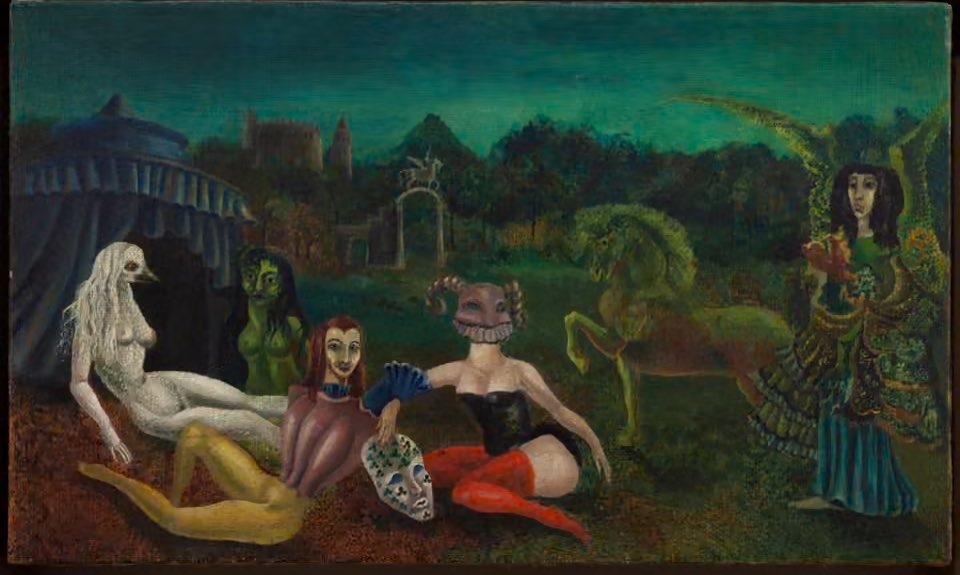
Down Below (1940) is a 65 x 83 cm tall painting that appears cluttered at first but is quite balanced when you take a closer look. There are 6 subjects in the frame, 5 women and 1 green coloured horse. Starting from the left part of the frame, the four women are seen sitting close to each other as compared to the fifth woman, who is standing at a distance looking at them. She appears to be the only complete human witnessing the other four with a look of sadness on her face.
There is a green horse next to her, perhaps a pet(?) standing at close proximity. The woman and the horse nearly blend into the heavily green background while the other four women sit highlighted in the forefront despite one of them also being completely green.
There is an old circus tent in the left corner of the frame that seems worn out either from repeated use or also as a symbol of her mental state. It appears almost as tall as the woman standing on the other end of the frame. Next to the tent we see a castle in great distance, embodying the beautiful life she had in France that is now a memory. There are trees all around and a shape that appears to be of a mountain just above the garden entrance at the centre of the frame — too far to access.
The unusual part about the painting is the four women sitting together. None of them appear to be fully human – and upon closer look they seem to be confronting the viewer.
The Land of Green and Magic
For the most part of the painting Carrington chose the colour green to visually describe what she longed for. Even the sky blends in with the ground and seems to be unrealistically adjusting to fit her desire. The colour represents openness and freedom (particularly creative) – both of which were snatched from her when she was sent to the asylum. But it also brings a sense of eeriness to the viewer — too present to turn away from but too uncomfortable to admit.
The grass on the left corner of the frame where the four women are placed appears dried and brown indicating that the four half women are the versions of Carrington that haunt and disturb her while she stands on the other end of the frame witnessing it helplessly. These are the versions that were revealed to her in the asylum when she could not understand the changes she was going through. Hence, the women do not have a complete human form.
Carrington also strongly believed that women were mediators of magical powers on earth and in her paintings they convey a strong celestial message by changing their shape and taking the form of birds and animals. It can be understood that she was experiencing a celestial shift within herself while she was trapped in a cage and therefore gave birth to these five magical women.
The painting is divided into three vertical halves. We see two women sitting at the left corner of the frame, in front of a blue abandoned circus tent – one green and one white with a bird’s head for a woman. These two women possibly indicate the caged freedom and creativity of Carrington.
She mostly uses dark shades in the painting with only one colour popping up – the bright red boots on the woman in the centre. She is the first thing the viewer sees when they look at the painting. She holds unusual power – with a mask on her face as well as in her hand and an open posture that highlights her body. She brings an element of desire into the picture – bold, luring and terrifying.
She almost leans into the woman sitting on her right – the woman with a beard and no hands that looks directly at the viewer. Her upper body is of some unknown creature and she represents the masculine energy held within a woman. These two women are the wild, untamed versions of Carrington that she wants to set free to explore further.
The right corner has a green horse that looks made from the bushes. Horses are the symbol of freedom and power in magic, something that she lacks in her life in the moment. The woman next to the horse is Carrington herself, dressed like Nature looking at the other end of the painting. She is mourning all the madness that unfolds in front of her. Or perhaps she looks at them in regret that these are all the versions she does not have complete access to.
Challenge to the Femme-Enfant
In the midst of all the madness Carrington does not forget one thing – her garden. The garden is not just a space she simply walks in or paints her subjects in. It represents something much more profound – her agency. There are several of her paintings where the space is an open garden and the subjects hold divine powers. But why is this garden of so much significance? The answer to this was given by Virginia Woolf in 1929.
Women in creative fields have the burden of proving their ability not just to their audience, but also to their fellow men. There has to be no room for mediocrity or too much space taken by her – she will be criticised either way. But that is not true for men. In Surrealism, men used women as objects of desire and reduced their identity to a mere muse — and it does not end there.
There exists an archetype in Surrealism called femme-enfant (woman child) which portrays women as beings with underdeveloped psyche incapable of making any decision for themselves.
André Breton, the writer of the Surrealist Manifesto wrote a book named Nadja (1928) about a man who falls in love with a mentally underdeveloped woman who becomes his muse. Not only does this infantilise full grown capable women and reduce their agency to zero, but also makes it even more difficult for them to get out of this already (forcefully) assigned image.
A femme enfant takes up no space. She is invisible without the presence of her man. Leonora Carrington hated this with fury. Hence it was of utmost importance to her to create a space that represents agency – and what other space better than an open garden?
Carrington, through Down Below, takes away the power of men to label her an exotic mad woman, she goes mad on her own terms.
Why Do You Need the Garden?
In a space that is designed to suppress a woman, Down Below stands as a symbol of a woman’s agency that she remains unapologetic about. Just as she needs money and a space of her own to write fiction, she needs the garden to water her voice and her intuitive creativity. An open space with an endless sky above that feels connected to her soul.
If one has a garden of their own, they do not have to hand the power of madness into a man’s hand. They own it like Carrington and turn even the state of despair into magic.


Great content! Keep up the good work!